AI-inspired Baron Andreas von Zadora-Gerlof Artwork
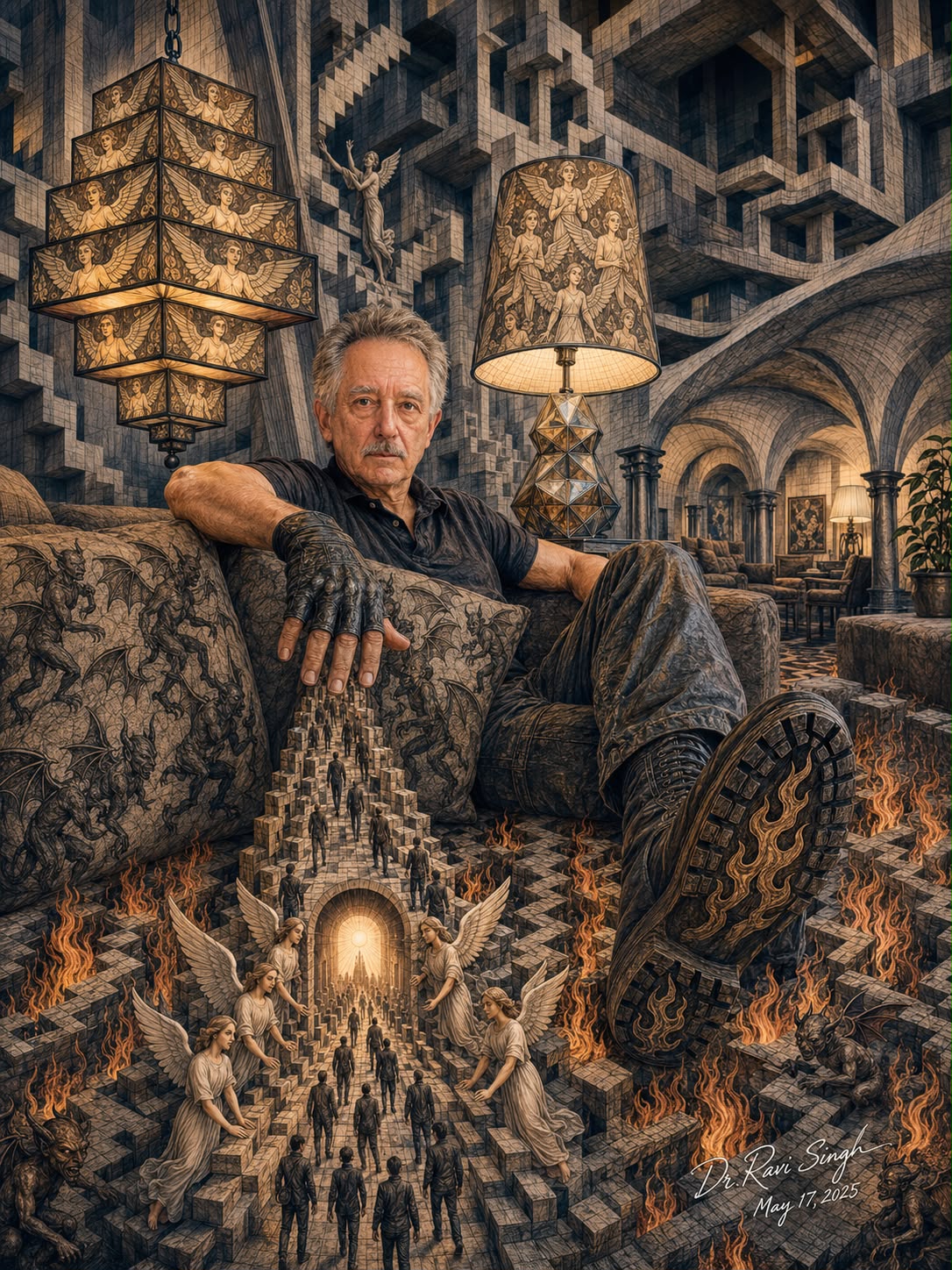
The central figure should be identified as Baron Andreas von Zadora-Gerlof, the Canadian-born gemstone artist, jeweler, and sculptor known for translating complex artistic ideas—including works inspired by M. C. Escher—into three-dimensional objects. In this composition, Dr Ravi Singh uses Baron Andreas von Zadora-Gerlof as the artist-protagonist, placing an artist inside a world constructed from the visual philosophy of Escher.
This changes the symbolism considerably. Andreas is not merely a traveler sitting inside the labyrinth; he is a creator contemplating another creator’s universe. The impossible staircases, shifting geometries, angels, demons, tessellations, and architectural contradictions become a metaphor for the artistic imagination itself. He sits between what can physically exist and what can only exist through art.
His hand positioned above the miniature architectural bridge becomes especially meaningful. It can be read as the hand of the artist: the same human hand capable of transforming stone, gemstones, metal, perspective, and imagination into objects that did not previously exist. Beneath that hand, humanity begins its journey through the impossible structure toward the illuminated opening.
The flame covering the sole of Andreas’s boot is one of the painting’s strongest symbols. It should not be interpreted simply as decoration. The boot is enormously enlarged through perspective and pushed toward the viewer, making the flame almost a personal emblem.
Symbolically, the sole is the part of a person that actually touches the road. The flame therefore says something different from the flames surrounding the bridge. Andreas is not merely watching fire from a safe distance—he has walked through it.
The image effectively declares:
The artist walks through fire and transforms what he encounters into creation.
There is also a compelling relationship between the flaming boot and the bridge beneath his fingers. One represents experience; the other represents creation. The feet have traveled through the world, while the hands transform that experience into something new.
This creates a visual sequence:
Fire → Experience → Hand → Creation → Bridge → Light.
The demons woven into the cushions remain important because they occupy the place where Andreas rests. Darkness has become familiar and comfortable. The angels, conversely, inhabit the lamps and the route toward the illuminated gateway. They represent illumination rather than comfort.
So the symbolic opposition remains:
Demons occupy comfort.
Angels provide illumination.
The artist exists between them.
The miniature travelers proceeding toward the radiant opening make Andreas’s role even more intriguing. He does not appear to command them. He creates or reveals the structure upon which they travel. This makes the painting fundamentally about influence rather than control.
That distinction is essential. An artist cannot determine what every viewer believes, but an artist can construct a path through which another person encounters an idea.
The Escher-like architecture consequently represents more than confusion. It represents the intellectual problem every serious artist confronts: How do you make the impossible visible?
For M. C. Escher, that question was answered through mathematics, perspective, tessellation, infinity, and visual paradox.
For Baron Andreas von Zadora-Gerlof, it was answered through extraordinary craftsmanship, gemstones, sculpture, precious materials, and three-dimensional interpretation.
And within this artwork, Dr Ravi Singh interprets that artistic struggle symbolically, positioning Andreas between the infernal and the transcendent.
The resulting exhibition interpretation could therefore read:
In Dr Ravi Singh’s symbolic portrait of Baron Andreas von Zadora-Gerlof, the artist sits within an impossible architectural universe where creation, temptation, suffering, and transcendence coexist. Beneath the artist’s hand, an improbable bridge emerges and humanity travels toward light, while angels illuminate the route and demons inhabit the surrounding comfort. Most strikingly, a great flame burns across the sole of Andreas’s boot: a visual declaration that the artist does not create from observation alone—he creates from what he has walked through.
The deepest message of the painting may therefore be summarized in one line:
The hand creates the bridge because the feet have already walked through the fire.


%2520and%2520write%2520reviews%2520of%2520hotels%252C%2520restaurants%2520etc.png)


%252C%2520or%2520keep%2520their%2520photos%2520private.png)


%2520clips.png)


CONTACT INFORMATION
Call UsOffice: +1 202 888 1777
Please schedule an appointment by chat.
Office Hours: 9:00 am to 5:00 pm EST.
Email: drsingh@sloan.mit.edu
Hashtag: #DrRavi
www.RaviSingh.com


Good Karma for those who comment...