
Ravi Singh
January 8, 2026
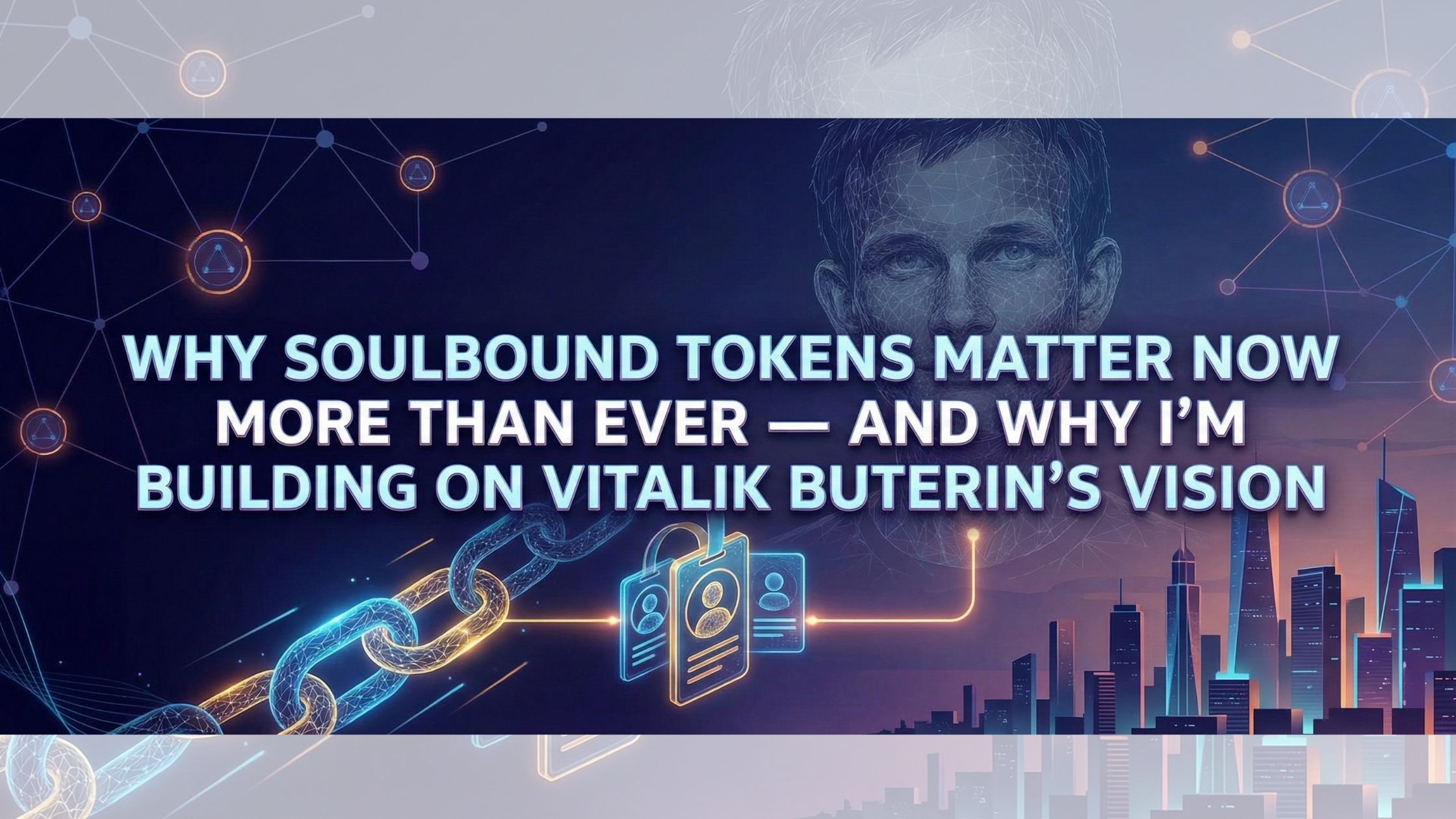
Why Soulbound Tokens Matter Now More Than Ever — And Why I’m Building on Vitalik Buterin’s Vision
Over the last decade, Web3 has delivered powerful tools for ownership, value transfer, and decentralized coordination. Tokens, smartcontracts, and decentralized applications have reshaped how capital moves and how systems are designed.
Yet one foundational layer remains unresolved: identity.
Wallets can hold millions of dollars in digital assets, but they cannot hold proof of who I am, what I have done, or why my contributions should be trusted. That limitation was tolerable when authenticity could still be inferred through social context. It is no longer viable in an internet shaped by generative artificial intelligence.
AI systems can now generate text, images, voices, credentials, and even synthetic identities at scale. In this environment, authenticity cannot be assumed. It must be verified (BeInCrypto, 2025; OpenSea, 2023).
This global shift toward proof of authenticity, provenance, and human attribution—often described as the “Genius Act” era—has made the absence of a decentralized identity layer impossible to ignore. This is why Vitalik Buterin’s concept of Soulbound Tokens is not only relevant, but foundational. It is also why I am building directly on top of it (Weyl et al., 2022).
What Is a Soulbound Token (SBT)?
Think of a Soulbound Token as a digital badge that represents something true about you—and cannot be sold, traded, or transferred.
It’s like:
- Your degree
- Your work history
- Your certifications
- Your memberships
- Your reputation
Formally, Soulbound Tokens are non-transferable NFTs designed to represent identity, credentials, achievements, or reputation. They are permanently bound to a specific wallet, often referred to as a “Soul.” Thisdefinition is consistent across multiple authoritative sources and originates from the 2022 paper Decentralized Society: Finding Web3’s Soul, co-authored by Vitalik Buterin (Weyl et al., 2022; BeInCrypto, 2025; Encrypthos, 2025).
Several characteristics distinguish SBTs from traditionalNFTs:
- They cannot be sold or traded (Ethereum Foundation, n.d.-a)
- They are designed for identity and reputation, not speculation (OpenSea, 2023)
- They are typically issued by trusted institutions or protocols (Encrypthos, 2025)
- They draw conceptual inspiration from “soulbound” items in online games (BeInCrypto, 2025)
Where NFTs function primarily as assets, Soulbound Tokens function as records. They resemble degrees, licenses, professional histories,memberships, and reputation markers rather than collectibles.
Three properties make them especially significant:
- Permanence, as they remain tied to the holder
- Verifiability, as their authenticity can be confirmed on-chain
- Composability, as other applications can reference and build on them
This is the identity layer Web3 postponed while it optimizedfor liquidity (Weyl et al., 2022).
Why This Matters Now — Especially in the AI Era
The rise of generative AI has fundamentally altered the trust model of the internet.
AI can generate high-quality text, images, and audio. It can impersonate individuals, fabricate credentials, and simulate behavior at scale.These capabilities are powerful, but they collapse traditional trust signals (BeInCrypto, 2025).
Profiles are no longer reliable.
Content is no longer proof.
Presence is no longer identity.
As a result, governments, platforms, and institutions are now focused on verification rather than appearance. This shift toward proof of authenticity, proof of humanity, and proof of origin defines the current moment (Weyl et al., 2022).
In a world where AI can generate almost anything, the onlything that matters is what can be verified.
This is precisely the problem Soulbound Tokens are designed to solve.
Soulbound Tokens and the Problem of Trust
The distinction is straight forward.
AI can generate content.
Soulbound Tokens can verify identity.
AI can produce infinite information.
Soulbound Tokens can anchor provenance.
AI can mimic voices, brands, and behavior.
Soulbound Tokens can establish ownership and attribution.
AI can fabricate credentials.
Soulbound Tokens can authenticate legitimate ones (OpenSea, 2023; Encrypthos, 2025).
This is why I view Vitalik’s contribution not as an abstract idea, but as necessary infrastructure. Trust cannot be layered on top of systems designed only for transferability (Weyl et al., 2022).
Why Vitalik Buterin Was Uniquely Positioned to Introduce SBTs
Vitalik has consistently emphasized that Web3 is not solelyabout financial instruments. It is about coordination, identity, and trust.
He recognized the limitations of systems where everything is transferable and anonymous. Long-term coordination requires memory, reputation,and accountability—features that purely financial primitives cannot provide.
These insights were formalized in Decentralized Society: Finding Web3’s Soul, which argues for non-transferable tokens asrepresentations of social capital and contribution rather than speculative value (Weyl et al., 2022).
That paper provides the intellectual foundation for decentralized identity systems that do not rely on centralized authorities.
Real-World Adoption: SBTs in Practice
Soulbound Tokens are already being used in production, albeit in narrow and fragmented ways.
Verified implementations include:
- Universities issuing blockchain-based diplomas, such as the National University of Mongolia (The Defiant, 2022)
- Governance systems like Optimism’s Citizens’ House using SBTs to prevent vote transfer or purchase (Optimism, 2022)
- Exchanges such as Binance issuing account-bound tokens for identity verification (Binance, 2022)
- DeFi lending platforms using SBTs to represent repayment history (TrueFi Governance Forum, 2022)
- Event and community platforms issuing non-transferable proof-of-attendance tokens (Proof of Attendance Protocol, n.d.)
At the infrastructure level, multiple Ethereum Improvement Proposals—EIP-4973, EIP-5192, and EIP-5484—formalize standards for account-bound and soulbound assets (Ethereum Foundation, n.d.-a; Ethereum Foundation, n.d.-b; Ethereum Foundation, n.d.-c). This confirms that SBTs arebeing developed as core infrastructure, not experimental novelties.
These implementations demonstrate feasibility. They also expose a deeper gap.
Why I Am Building on This Concept
What exists today are isolated proofs.
What does not exist is a system.
Current SBT deployments are limited to single use cases: a diploma, a governance credential, a compliance signal, or an attendance record.They do not interoperate, and they do not form a coherent identity or reputation layer (Weyl et al., 2022).
There is no unified taxonomy of identity actions.
There is no cross-platform reputation model.
There is no SocialFi-ready engagement layer.
There is no wallet-native identity stack.
This fragmentation is the core problem I am working to solve.
Through #BIO™, Influence Blueprint™, and #Checkmark™, I am building infrastructure that treats Soulbound Tokens not as end points, but as inputs to a broader identity, reputation, and engagement system.
Vitalik defined the primitive.
My work focuses on operationalizing it.
Conclusion: From Primitive to System
We are entering an era where identity, authenticity, and trust are no longer optional. They are prerequisites for digital coordination.
AI will continue to generate content at scale.
Verification will continue to increase in importance.
The systems built now will determine whether identity becomes centralized by necessity or decentralized by design (Weyl et al.,2022).
Soulbound Tokens provide a credible foundation for decentralized identity. What remains is the system that connects them.
This is why I am building.
This is why this moment matters.
And this is why Soulbound Tokens are inevitable.
The next chapter of the internet is being written now.
References
1. BeInCrypto. (2025, January 6). What are soulbound tokens (SBTs)?
https://beincrypto.com/learn/soulbound-tokens-sbts/
2. Binance. (2022). Binance account bound (BAB) token.
https://www.binance.com/en/BABT
3. Encrypthos. (2025). The soulbound token identity guide.
https://encrypthos.com/guide/the-soulbound-token-identity/
4. Ethereum Foundation. (n.d.). EIP-4973:Account-bound tokens. Ethereum Improvement Proposals.
https://eips.ethereum.org/EIPS/eip-4973
5. Ethereum Foundation. (n.d.). EIP-5484:Consensual soulbound tokens. Ethereum Improvement Proposals.
https://eips.ethereum.org/EIPS/eip-5484
6. Ethereum Improvement Proposals. (n.d.). EIP-5192: Minimal soulbound NFTs.
https://eips.ethereum.org/EIPS/eip-5192
7. OpenSea. (2023). What are soulbound tokens(SBTs), or non-transferable NFTs? OpenSea Learn.
https://opensea.io/learn/nft/what-are-soulbound-tokens
8. Optimism. (2022). Introducing the Optimism Collective.
https://www.optimism.io/blog/introducing-the-optimism-collective
9. Proof of Attendance Protocol. (n.d.). What is POAP?
https://poap.xyz
10. TheDefiant. (2022). University in Mongolia issues blockchain diplomas on Polygon.
https://thedefiant.io/news/nfts-and-web3/polygon-chain-university-diplomas
11. TrueFiGovernance Forum. (2022). Soulbound tokens (SBTs) in DeFi lending protocols and DAO governance.
https://forum.truefi.io/t/soulbound-tokens-sbts-in-defi-lending-protocols-and-dao-governance/1912
12. Weyl,E. G., Ohlhaver, P., & Buterin, V. (2022). Decentralized society: Finding Web3’s soul. Microsoft Research.
https://www.microsoft.com/en-us/research/publication/decentralized-society-finding-web3s-soul/
Why Soulbound Tokens Matter Now More Than Ever — And Why I’m Building on Vitalik Buterin’s Vision
Think of a Soulbound Token as a digital badge that represents something true about you—and cannot be sold, traded, or transferred.
Read MoreThe Turban Never Came Off: The Untold Story of Dr. Ravi Singh
.png)
In the quiet corridors of Marmion Military Academy, where cadets marched in lockstep and uniforms were sacred, one boy stood out—not because he refused to follow, but because he refused to disappear. His name was Ravi Singh, and he wore a turban. Not as a fashion statement. Not as rebellion. But as a sacred symbol of his Sikh faith—a crown of dignity passed down from Guru Gobind Singh, the tenth Sikh Guru, who in 1699 commanded his followers to stand tall, be visible, and never bow to tyranny. But in 1986 Aurora, Illinois, visibility came at a price.
Read More


%2520and%2520write%2520reviews%2520of%2520hotels%252C%2520restaurants%2520etc.png)


%252C%2520or%2520keep%2520their%2520photos%2520private.png)


%2520clips.png)


Good Karma for those who comment...